StudyCountry

StudyCountry is a mini encyclopedia for students interested in traveling to different parts of the world.

Service

We value truth and honesty in our business, excellence in the quality of our services, the dignity of all individuals, and our purpose expressed in our mission statement.

Our Mission

We decided to develop a directory for all schools and students around the world that also included exchange students, language exchanges, secondary school exchanges and student housing listings.

Get latest Information about different countries for students

You can find information for students about every country in the world.

Study programs and key information

Find study programs and key information for studying in almost every country in the world.

Wednesday, 21 June 2017

How is Jamaica education system?


Jamaica is a beautiful island country located in the Caribbean Sea. The country is the largest island in the Caribbean and has beautiful tourist attraction sites that will make you not want to leave!

With regards to education, the system is modelled after the British Education system. This is because the country is a Commonwealth realm and Queen Elizabeth II is its head of state and monarch.

Everyone has to go through early childhood education which basically includes privately operated, basic and infant pre-schools. Students go through early childhood education from the ages of one to six. Currently, there are about 2,595 early childhood schools; 100 of these are infant schools, 402 day care centers, and 183 have not been given recognition by the government.


EDUCATION IN JAMAICA


After early childhood education, students are expected to go through primary education. This stage is meant
to offer them important educational needs and to make them ready for secondary education. Children attending primary school are normally between 5 -11 years of age. The total duration taken to complete primary education is 6 years. Primary education is free and compulsory, and learning is conducted in English. The schools can either be primary schools, private preparatory schools, or state-owned.

Secondary education is in two phases. Lower School which is from Form 1 – Form 3 or grades 7-9. Here, students are taught various subjects including French and Spanish. The second phase is upper school which is from Form 4-5 or grades 10-11. Students at this stage sit fir the Caribbean Council’s O-Level examinations. English and mathematics are compulsory subjects. Students can choose from Geography, History, Physics, Biology, Chemistry, French, Religious Education, and French among others to make a total of 6-10 subjects. Students also have the option of attending sixth form where they sit for the Caribbean Advanced Proficiency Exams (CAPE).

CAPE exams are a requirement for one to get admission into the university. One can also qualify to join the university after obtaining a 3-year diploma from a recognized post-secondary college. Colleges in Jamaica do not grant a bachelor’s degree; universities are the only institutions that grant degrees.


Image result for jamaica education


There are special programs offered to students, for instance, the Tourism Education Program which offers a subject called Jamaica Tourist Bsm. This is taught at all levels of education, i.e. from early childhood to secondary and it works in agreement with the set curriculum which entails Social Studies, Mathematics, Resource and Technology which carries tourism linked concepts and materials. There is also a summer school program. This is basically a five-day workshop where learners get to work in the tourism environment thus acquiring firsthand experience. Students also go for field trips to the tourist attractions and top students get a one month ‘internship’ in tourism related institutions and hotels.

Education in Jamaica country is not all work and no play. Students take part in debate competitions and school’s challenge quizzes. They participate in sports, for instance, the Track and Field event where students participate in the Boys and Girls School’s Championships, for cricket they take part in the Grace Shield competition, and football, the Manning Cup and DaCosta Cup competitions.


Source of post : https://studycountry.wordpress.com/2017/06/21/how-is-jamaica-education-system/

Sunday, 18 June 2017

What's the history of India?


One of the great early civilizations made its home in the Indus River Valley around 2500 BC along the Indus River valley. Its great cities were Mohenjo-daro and Harappa. Nobody is quite sure what caused their decline. Then between 1500 and 200 BC, Aryan invaders from Central Asia came to India and pushed the original Dravidian inhabitants south.


http://www.autotravel.ua/images/doc/7/a/7ad3f86-1.jpg

Over the next few centuries, several kingdoms rose and fell in different parts of the country, including the Maurya kingdom and the Gupta empire. India was invaded by various people including the Huns and the Mongols. Most notable were the Muslim Ghurs in 1192, who brought the entire Gangetic basin under their control within 20 years. In the south, the mighty Hindu kingdom of Vijayanagar, and the fragmented Bahmani Islamic kingdom came to power.


https://www.youngisthan.in/hindi/wp-content/uploads/2016/05/gaandhaar-pic-10.jpg

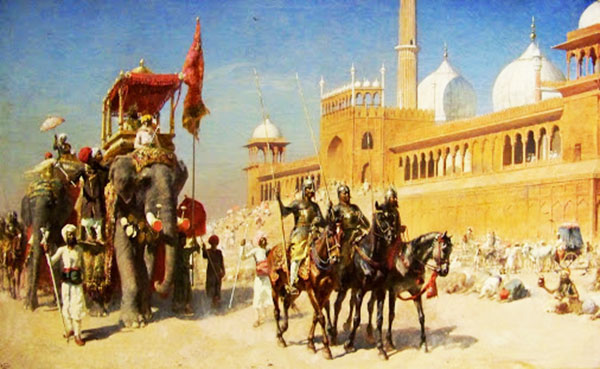
The Mughal emperors defeated the Sultan of Delhi in 1525, and ushered in another artistic golden age. The Maratha Empire grew during the 17th century and gradually took over more of the Mughals' domain. The Marathas consolidated control of central India until they fell to the last great imperial power, the British.


The British established their power over India by 1803 and started using the country as a place to make money. Unlike the Mughals, they did not assimilate into the culture, nor did they think of the country as their own. The treated the local Indian people as ‘natives’. The Uprising (also known as the War of Independence) in northern India in 1857 was the first mark of protest.

http://hyderabad-india-online.com/wp-content/uploads/2013/10/gandhi-satyagraha.png


By the turn of the 20th century, Indians had started opposing foreign rule in earnest. The struggle for freedom was fought on many fronts by many people across the country, most significant of them being Gandhi who adopted a policy of passive resistance, or satyagraha.


https://shanthanubh.files.wordpress.com/2009/08/india.jpg


India finally attained independence on 15 August, 1947. Muslim parties had fought for a separate country all along and so the country was also divided to form the separate nation of Pakistan. When the dividing line was announced, the greatest exodus in human history took place as Muslims moved to Pakistan and Hindus and Sikhs relocated to India. Over 10 million people changed sides and even the most conservative estimates calculate that 250,000 people were killed.

In the years after independence, India struggled to grow its economy but finally started doing that only as recently as five years ago.


Get more details: http://www.studycountry.com/guide/IN-history.htm